D1 vs D2 vs D3: Which NCAA Division Is Right for Your Student-Athlete?
Understand the key differences between NCAA Division I, II, and III programs. Compare scholarships, academics, competition level, and lifestyle to find the right fit.
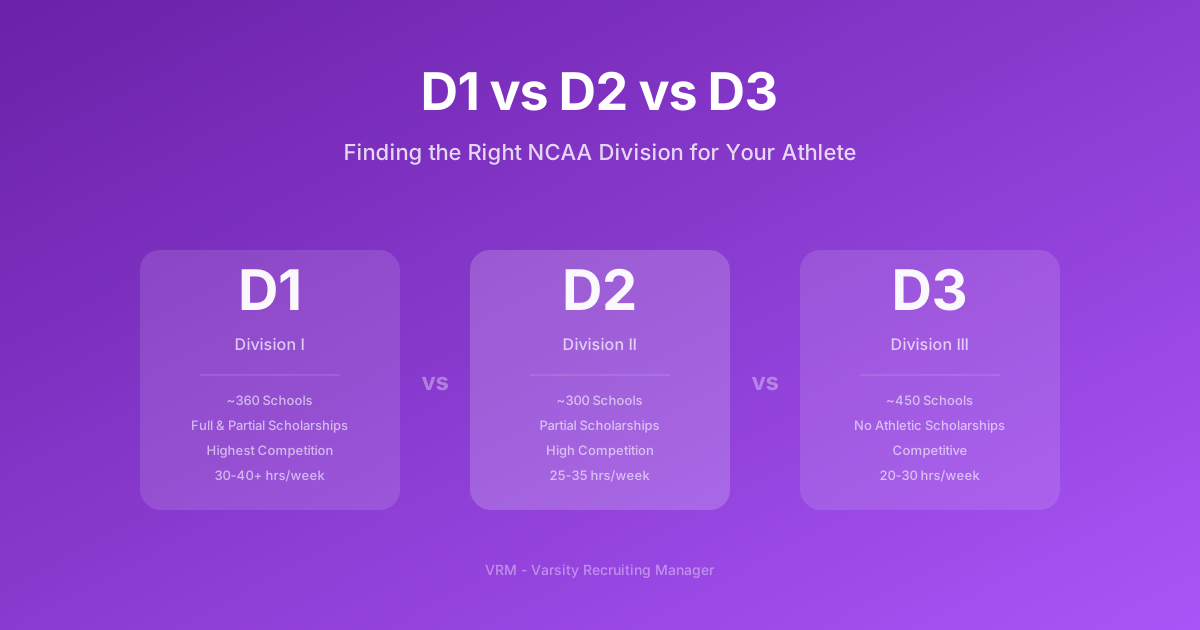
When most families think about college athletics, they think about Division I. The big stadiums, the TV contracts, the scholarships. But the NCAA has three divisions, and the right one for your student-athlete might not be the one you expect. Choosing the wrong division can mean sitting on the bench for four years, struggling academically, or missing out on an experience that could have been transformative.
This guide breaks down the real differences between D1, D2, and D3 so you can make an informed decision based on your student-athlete's actual abilities, goals, and priorities.
Understanding the Three Divisions
The NCAA created three divisions to accommodate the enormous range of schools, budgets, and athletic philosophies in American higher education. Each division has different rules about scholarships, recruiting, and the time commitment expected of athletes. None is inherently better than the others. They serve different purposes and attract different types of student-athletes.
Division I: The Highest Profile
Division I is the most visible level of college athletics. It includes about 360 schools, ranging from massive state universities to smaller private institutions. D1 is further divided into the Football Bowl Subdivision (FBS) and the Football Championship Subdivision (FCS) for football, but for all other sports, D1 is a single tier.
D1 programs have the largest athletic budgets, the most extensive coaching staffs, and the highest level of competition. They also have the most demanding time commitments. Student-athletes at D1 programs routinely spend 30 to 40 hours per week on their sport when you factor in practice, film study, weight training, travel, and competition.
Scholarships vary by sport. In head-count sports like D1 football (FBS) and basketball, every scholarship is a full ride. In equivalency sports like swimming, soccer, track, and most others, coaches divide a fixed number of scholarship dollars among the roster. This means many D1 athletes on scholarship receive partial awards that cover only a fraction of the total cost.
Division II: The Middle Ground
Division II includes about 300 schools and is often described as offering the best balance between athletics and academics. D2 athletes are serious competitors who train and travel extensively, but the time commitment is generally somewhat less consuming than D1.
D2 programs offer athletic scholarships, but the total amount available per team is significantly less than D1. Like D1 equivalency sports, D2 coaches divide their scholarship money across the roster, and most athletes receive partial awards. However, D2 athletes often receive a combination of athletic and academic aid that can meaningfully reduce the cost of attendance.
One important difference: D2 schools are more likely to be in smaller cities and towns. The campus culture often feels tighter and more close-knit than at a large D1 university.
Division III: Athletics and Academics in Balance
Division III is the largest NCAA division with about 450 schools and over 200,000 athletes. The defining characteristic of D3 is that it does not offer athletic scholarships. Athletes play purely for the love of the sport and the college experience.
Do not let the lack of athletic scholarships fool you into thinking D3 is not competitive. D3 athletics are intense. Athletes train year-round, travel for competition, and take their sport seriously. The difference is that D3 places an institutional emphasis on balancing athletics with the full college experience, including academics, research, internships, and campus life.
Many D3 schools are among the most academically prestigious institutions in the country. Schools like MIT, Johns Hopkins, Emory, Carnegie Mellon, the University of Chicago, and the entire Ivy League (which is D1 but does not offer athletic scholarships) attract elite students who also happen to be excellent athletes.
While D3 schools cannot offer athletic scholarships, they can and do offer substantial academic and need-based financial aid. Coaches often work closely with admissions and financial aid offices to support recruited athletes.
The NAIA is a separate athletic association from the NCAA with about 250 member schools. NAIA schools can offer athletic scholarships and are often comparable in size and competition level to D2 or small D1 programs. If your student-athlete is exploring options, do not overlook NAIA schools.
Division Comparison at a Glance
| Factor | Division I | Division II | Division III | |---|---|---|---| | Number of Schools | ~360 | ~300 | ~450 | | Athletic Scholarships | Yes (full and partial) | Yes (partial, less than D1) | No athletic scholarships | | Financial Aid | Athletic, academic, need-based | Athletic, academic, need-based | Academic and need-based only | | Time Commitment | 30-40+ hrs/week | 25-35 hrs/week | 20-30 hrs/week | | Competition Level | Highest | High | Competitive | | Recruiting Intensity | Very high | Moderate to high | Moderate | | School Size | Small to very large | Small to medium | Small to medium | | TV/Media Exposure | Significant | Limited | Rare | | Post-Sport Career Prep | Varies widely | Generally good | Often excellent | | Study Abroad/Internships | Difficult during season | Possible with planning | More common and accessible |
Scholarships: What the Numbers Actually Mean
Scholarship conversations are where the most confusion and disappointment occur in the recruiting process. Here is what families need to understand.
D1 Scholarship Reality
In D1 head-count sports (men's and women's basketball, FBS football, women's volleyball, women's tennis, women's gymnastics), every scholarship is a full athletic scholarship. But these sports have roster limits and scholarship caps. For example, FBS football has 85 scholarships for a roster that often exceeds 100 players.
In D1 equivalency sports, the scholarship pool is divided among more athletes. A D1 women's soccer team might have 9.9 scholarships to distribute among 25 to 30 players. That means the average scholarship covers roughly one-third of the total cost. Many D1 athletes in equivalency sports receive awards of 25 to 50 percent of tuition and fees.
D2 Scholarship Reality
D2 scholarship limits are lower than D1 across the board. A D2 women's soccer team might have 9.9 scholarships as well, but the per-scholarship value is often lower because D2 schools have smaller athletic budgets. Partial scholarships of 10 to 40 percent of total cost are common.
D3 Financial Aid Reality
D3 schools cannot award any financial aid based on athletic ability. However, many D3 institutions have large endowments and generous financial aid programs. A student-athlete recruited to a well-funded D3 school may receive a merit scholarship and need-based aid package that covers more of the total cost than a partial D1 or D2 athletic scholarship would.
This is one of the most important and least understood facts in college recruiting: the out-of-pocket cost at a D3 school with strong financial aid can be lower than the out-of-pocket cost at a D1 school with a partial athletic scholarship.
Competition Level: Finding the Right Fit
Playing time matters. The experience of contributing to a team is dramatically different from the experience of sitting on the bench. When evaluating divisions, the single most important question is: where will my student-athlete actually play?
The Bench Warming Problem
Every year, elite high school athletes commit to D1 programs where they never crack the starting lineup. They were stars at the high school and club level, but the jump to D1 is enormous. The talent gap between a high school standout and a D1 starter is wider than most families realize.
A student-athlete who would ride the bench at a mid-major D1 program might be an all-conference player at a strong D2 school. An athlete who would be a rotation player at D2 might be the best player on a D3 roster. Playing, contributing, and leading are what make the college athletic experience meaningful.
How to Assess the Right Level
Ask club and high school coaches for an honest assessment. They have seen thousands of athletes and can usually gauge where a player fits. Attend camps at schools in different divisions and see how your student-athlete compares to the athletes already on those rosters. Watch film of current college games at each level and honestly assess the speed, size, and skill.
If your student-athlete is consistently one of the best players at a D2 camp, that is valuable information. It might mean D2 is the right competitive level, or it might mean they should look at lower-tier D1 programs. Use these data points to calibrate.
The Student-Athlete Lifestyle by Division
The day-to-day experience of being a college athlete varies significantly by division, and this is where many families fail to dig deep enough before committing.
Division I Lifestyle
At D1, your sport comes first in almost every practical sense. Morning weights, afternoon practice, evening film sessions, and weekend travel consume most of your time. Choosing a major may be constrained by your practice schedule. Study abroad during your sport's season is almost impossible. Many D1 athletes describe their experience as rewarding but all-consuming.
Division II Lifestyle
D2 provides a competitive athletic experience with somewhat more flexibility. Athletes still train hard and travel for competition, but the overall time commitment is lower. There is generally more room for academic exploration, part-time work, and extracurricular involvement. Many D2 athletes describe their experience as the best of both worlds.
Division III Lifestyle
D3 athletes are committed and competitive, but they also tend to be deeply involved in campus life outside of their sport. It is common for D3 athletes to hold leadership positions in student organizations, participate in undergraduate research, complete internships during the academic year, and study abroad. The athletic experience is intense, but it is integrated into a broader college experience rather than dominating it.
A Decision Framework for Your Family
Choosing the right division is ultimately a personal decision that depends on your student-athlete's abilities, priorities, and goals. Here is a framework to guide the conversation.
Choose D1 if:
- Your student-athlete is in the top tier of their age group nationally or regionally
- Athletics is their primary passion and they want it to be the centerpiece of their college experience
- They are comfortable with significant time demands and potential limitations on academic choices
- They are being actively recruited by D1 programs and coaches have expressed genuine interest
Choose D2 if:
- Your student-athlete is highly competitive but may not be at the elite D1 level
- They want a strong athletic experience balanced with meaningful academic and social engagement
- Athletic scholarship money would help with college costs but a full ride is unlikely
- They want a competitive environment without the all-consuming intensity of D1
Choose D3 if:
- Your student-athlete loves their sport and wants to keep playing but also has significant academic and extracurricular goals
- Academics, research opportunities, or specific programs are a high priority
- The overall college experience matters as much as or more than the athletic experience
- They are attracted to schools that happen to be D3 institutions (many top academic schools)
- They want to play and contribute rather than sit on the bench at a higher division
Many families find that their student-athlete fits in more than one division. If that is the case, build a list that spans divisions and let the specific schools, coaches, campus culture, and financial aid offers guide the final decision. The right school at the wrong division is still the wrong choice.
Beyond the NCAA: NAIA and Junior College
The NCAA is not the only path to college athletics. The NAIA includes about 250 schools that offer athletic scholarships and competitive programs. NAIA recruiting rules are generally less restrictive than the NCAA, and many NAIA programs provide excellent athletic and academic experiences.
Junior colleges (JUCOs) are another option, particularly for athletes who need to improve academically before transferring to a four-year school, or who are late bloomers athletically. A strong JUCO season can open doors to D1, D2, or NAIA programs that were not available out of high school.
Making the Final Choice
The best college athletic experience is one where your student-athlete is on the field, in the classroom, and engaged on campus. Division prestige means nothing if your child is unhappy, struggling academically, or never getting off the bench.
Visit schools at every level. Talk to current athletes about their daily experience. Ask coaches about their philosophy on playing time, academic support, and player development. Look at graduation rates and post-graduation career outcomes.
The right division is not the most prestigious one. It is the one where your student-athlete will thrive as both a person and a player. Let the school, the program, the coaches, and the overall fit drive the decision, not the Roman numeral next to the division name.